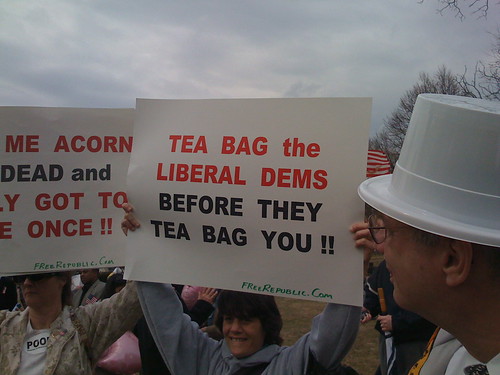
There has always appeared something a bit unhinged about the Tea
Baggers (as they first wanted to be called). Too much anger, too much hate. Two emotions I don't deal with either internally or externally very well. There is a lot of racism involved, though that supplies only part of the electric force running through the synapses to motivate the limbs of the creature. To some extent they are channeling age old populist anger at the elites. Now that is something I have more sympathy with, but it is exceeding dangerous for the
Repubs, and not much better for the Demos. It is a force that is destructive to the political process itself because the process is seen as in the hands of elites that are inimical almost by definition to popular forces.
Is the movement coherent, does it have a sane agenda past the inane slogans and cheers? I doubt but we will see. In the meantime, J M Bernstein, a professor of philosophy, has a smart take on the deep motivating forces behind the movement in a
little essay in today's NY Times. You should read it all, but here is some of it:
The seething anger that seems to be an indigenous aspect of the Tea Party movement arises, I think, at the very place where politics and metaphysics meet, where metaphysical sentiment becomes political belief. More than their political ideas, it is the anger of Tea Party members that is already reshaping our political landscape. ..
... In a bracing and astringent essay in The New York Review of Books, pointedly titled “The Tea Party Jacobins,” Mark Lilla argued that the hodge-podge list of animosities Tea party supporters mention fail to cohere into a body of political grievances in the conventional sense: they lack the connecting thread of achieving political power. It is not for the sake of acquiring political power that Tea Party activists demonstrate, rally and organize; rather, Lilla argues, the appeal is to “individual opinion, individual autonomy, and individual choice, all in the service of neutralizing, not using, political power.” He calls Tea Party activists a “libertarian mob” since they proclaim the belief “that they can do everything themselves if they are only left alone.”
... Where do such anger and such passionate attachment to wildly fantastic beliefs come from?
His conclusion seems to fit the odd contradictions seen in most comments from Tea Baggers:
My hypothesis is that what all the events precipitating the Tea Party movement share is that they demonstrated, emphatically and unconditionally, the depths of the absolute dependence of us all on government action, and in so doing they undermined the deeply held fiction of individual autonomy and self-sufficiency that are intrinsic parts of Americans’ collective self-understanding.
Well, as Chou-en-Lai once said, too soon to tell. But I think there is something to Bernstein's analysis, though it seems incomplete. As of yet the movement has not budged out of its low numbers and has not demonstrated any electorial clout beyond primaries which can be swung by the oddest little things (Alvin Greene!)
Labels: political class, politics, Republicans, Tea Party